- Herpes simplex virus - (https://www.who.int/news-room/fact-sheets/detail/herpes-simplex-virus)
- Herpes simplex viruses: is a vaccine tenable? - (https://www.ncbi.nlm.nih.gov/pmc/articles/PMC151069/)
- Cold sores - (https://www.betterhealth.vic.gov.au/health/conditionsandtreatments/cold-sores)
- Cold sores: Overview - (https://www.ncbi.nlm.nih.gov/books/NBK525782/)
- Canker sores (mouth ulcers): Overview - (https://www.ncbi.nlm.nih.gov/books/NBK546250/)
- Fever Blisters & Canker Sores - (https://www.nidcr.nih.gov/health-info/fever-blisters-canker-sores)
- Herpes can Happen Anyone - (https://newsinhealth.nih.gov/2018/06/herpes-can-happen-anyone)
- Herpesviruses: latency and reactivation – viral strategies and host response - (https://www.ncbi.nlm.nih.gov/pmc/articles/PMC3809354/)
- Herpetic Whitlow - (https://www.ncbi.nlm.nih.gov/books/NBK482379/)
- Basics of HSV (Herpes Simplex Virus) Keratitis - (https://www.cdc.gov/contactlenses/viral-keratitis.html)
- Herpesviruses: latency and reactivation - viral strategies and host response - (https://www.ncbi.nlm.nih.gov/pmc/articles/PMC3809354/)
- Clinical efficacy of topical docosanol 10% cream for herpes simplex labialis: A multicenter, randomized, placebo-controlled trial - (https://pubmed.ncbi.nlm.nih.gov/11464183/)
- Penciclovir cream for the treatment of herpes simplex labialis. A randomized, multicenter, double-blind, placebo-controlled trial. Topical Penciclovir Collaborative Study Group - (https://pubmed.ncbi.nlm.nih.gov/9134943/)
- Herpes Labialis: A New Possibility for Topical Treatment with Well-Elucidated Drugs - (https://pubmed.ncbi.nlm.nih.gov/34197838/)
- Microemulsion-Based Oxyresveratrol for Topical Treatment of Herpes Simplex Virus (HSV) Infection: Physicochemical Properties and Efficacy in Cutaneous HSV-1 Infection in Mice - (https://www.ncbi.nlm.nih.gov/pmc/articles/PMC3513452/)
- Metal oxide sunscreens protect skin by absorption, not by reflection or scattering - (https://pubmed.ncbi.nlm.nih.gov/26431814/)
- Tannic Acid with Antiviral and Antibacterial Activity as A Promising Component of Biomaterials-A Minireview - (https://pubmed.ncbi.nlm.nih.gov/32698426/)
- Cold applications for the treatment of pain - (https://pubmed.ncbi.nlm.nih.gov/17089230/)
- Tannic acid modified silver nanoparticles show antiviral activity in herpes simplex virus type 2 infection - (https://pubmed.ncbi.nlm.nih.gov/25117537/)
- Success of L-lysine therapy in frequently recurrent herpes simplex infection. Treatment and prophylaxis - (https://pubmed.ncbi.nlm.nih.gov/3115841/)
- Efficacy of plant products against herpetic infections - (https://pubmed.ncbi.nlm.nih.gov/21607799/)
- Herpes Simplex Type 1 - (https://www.ncbi.nlm.nih.gov/books/NBK482197/)
- Herpes - oral - (https://medlineplus.gov/ency/article/000606.htm)
About
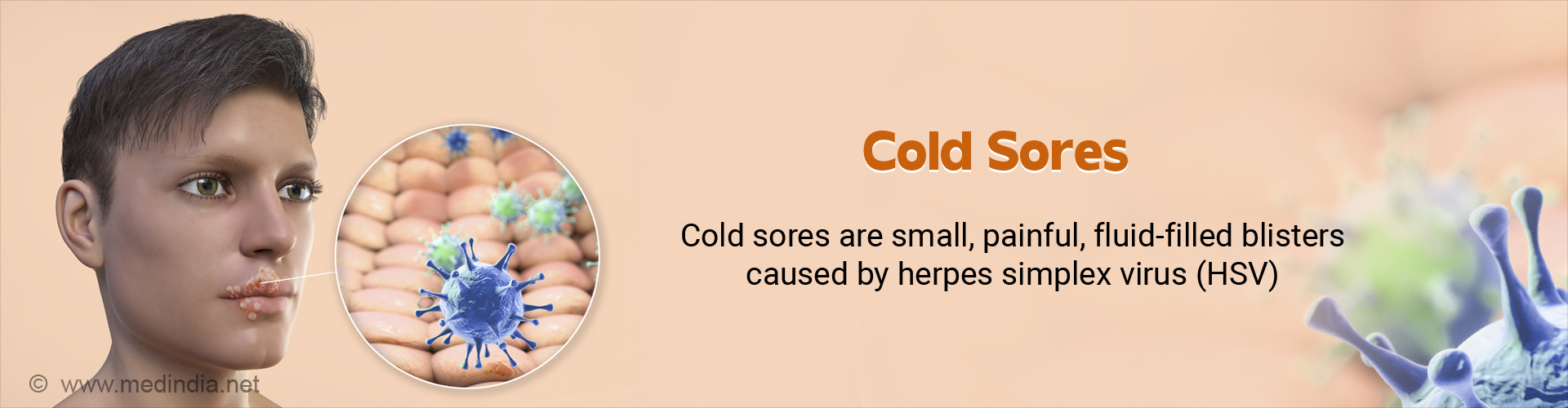
Herpes labialis or orolabial herpes is an infection which
causes groups of small blisters on the lip and around the mouth by herpes simplex virus (HSV-1)(1✔ ✔Trusted Source
Herpes simplex virus
Go to source). It is more commonly referred to as cold sores or fever blisters, but they have nothing to do with cold or fever.
Greek scholars, including Hippocrates, initiated the use of the word 'herpes' to describe these lesions caused by the virus we now call herpes simplex. The word 'herpes' means to creep or crawl. The Greeks describe it as the manner in which these lesions spread(2✔ ✔Trusted Source
Herpes simplex viruses: is a vaccine tenable?
Go to source).
The first outbreak is confusing as the patient gets a tingling sensation that is accompanied with a burning and itchy sensation, and just when the patient feels that it will subside, a blister or cluster of small blisters appear at the corner or edge of the lips which are painful and reddish purple in color at first. Occasionally, they occur on the nostrils, chin or fingers. Although unusual, they may also occur inside the mouth (gums or hard palate)(3✔ ✔Trusted Source
Cold sores
Go to source). With each new breakout cold sores typically form in the same location as they have before. These blisters may break open and leak a clear fluid; then scab over after a few days. They usually heal in several days to 2-weeks(4✔ ✔Trusted Source
Cold sores: Overview
Go to source).
Canker sores are white-reddish, inflamed spots that occur inside the mouth. Canker sores are painful, but they usually heal on their own and do not cause any problems(5✔ ✔Trusted Source
Canker sores (mouth ulcers): Overview
Go to source). Cold sores are painful, fluid-filled sores that develop on the lips or around the mouth, whereas canker sores develop inside the mouth(6✔ ✔Trusted Source
Fever Blisters & Canker Sores
Go to source).
The herpes simplex virus is not completely eliminated from the body. Following orofacial infection, it remains dormant in the facial nerves, periodically reactivating to create sores in the same area of the mouth or face at the site of the original infection. An infected person typically experiences 1-3 outbreaks every year(7✔ ✔Trusted Source
Herpes can Happen Anyone
Go to source). The frequency and severity of the outbreaks decreases with time(8✔ ✔Trusted Source
Herpesviruses: latency and reactivation – viral strategies and host response
Go to source).
Advertisement
What are the Causes of Cold Sores?
Cold sores are caused by a virus that is highly infectious and is called the herpes simplex virus (HSV). There are actually eight different types of human herpes simplex viruses but only two types can cause cold sores. These two types are categorized as-
- Herpes simplex virus-1 (HSV- 1) - The herpes simplex virus-1 causes cold sores.
- Herpes simplex virus-2 (HSV-2) - The herpes virus-2 generally causes genital herpes and at times herpes labialis too(1✔ ✔Trusted Source
Herpes simplex virus
Go to source).
The most common route by which the herpes virus is transmitted to others is by way of direct skin-to-skin contact. The virus enters the body through a cut inside or around the mouth either by kissing someone with cold sores or brushing up against their lesion accidentally. It is transmitted through oral sex. It can also spread by way of an intermediary object such as an eating utensil, cup, lipstick or lip balm applicator, toothbrush, or even a face towel(4✔ ✔Trusted Source
Cold sores: Overview
Go to source).
Cold sores can also spread to other areas of the body of an infected person.
- The herpes simplex virus can cause herpetic whitlow, a painful infection of the fingers(9✔ ✔Trusted Source
Herpetic Whitlow
Go to source). - If the herpes virus infects the eye, it can cause a chronic corneal ulcer(10✔ ✔Trusted Source
Basics of HSV (Herpes Simplex Virus) Keratitis
Go to source).
The HSV lies in a dormant state in the body and has a tendency to recur. It hides inside the nerve cells closest to the face. As the virus travels along the nerve tissue, the victim feels a tingling sensation. Following this tingly and itchy feeling, the area swells to form one or several painful pimples which become weeping open sores or blisters. The sore heals without leaving a scar(4✔ ✔Trusted Source
Cold sores: Overview
Go to source).
A person with a cold sore needs to be careful so as not to transmit the infection to others. People with an outbreak should not pick or scratch the blisters and should wash the hands every time after touching it.
Advertisement
What Causes an Outbreak of Cold Sores?
The onset of herpes outbreaks often coincides with those periods when a person's immune system is stressed or weakened. During ‘normal’ times a person's immune system is able to keep the herpes virus in check, but when a person's immune system is compromised the herpes virus is able to overcome a person's natural defenses and cause the formation of a lesion(11Herpesviruses: latency and reactivation - viral strategies and host response
Go to source).
Factors that trigger cold sore outbreaks-
- Emotional stress
- Physical stress and fatigue
- Illness (including a cold or flu)
- Injury to the lips or skin, such as physical trauma or severe chapping
- Injury to the lips from excessive exposure to bright sunlight or ultraviolet lamps
- Menstruation or pregnancy
- Very hot or cold temperatures
- An immune system deficiency(4✔ ✔Trusted Source
Cold sores: Overview
Go to source)
What are the Symptoms of Cold Sores?
Symptoms before the appearance of the blisters(4✔ ✔Trusted Source
Cold sores: Overview
Go to source) -
- Pain around the mouth and lips
- Fever
- Sore throat
- Swollen glands in the neck or other parts of the body
- Drooling is seen in small children
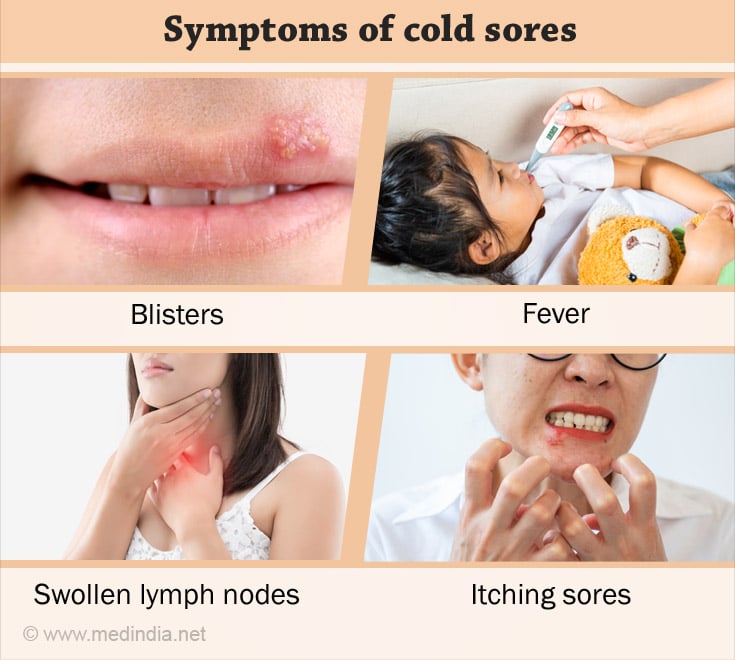
Following the appearance of the blisters; the cold sores usually break open, leak a clear fluid, and then crust over and disappear after several days to 2-weeks. Cold sores can be very painful in some people.
Symptoms of a primary orolabial infection occur between three days and one week after the exposure. Patients will often experience a viral prodrome consisting of malaise, anorexia, fevers, tender lymphadenopathy, localized pain, tenderness, burning, or tingling prior to the onset of mucocutaneous lesions. Primary HSV-1 lesions usually occur on the mouth and lips. Patients will then demonstrate painful grouped vesicles on an erythematous base. These vesicles exhibit a characteristic scalloped border. These vesicles may then progress to pustules, erosions, and ulcerations. Within 2 to 6 weeks, the lesions crust over and symptoms resolve.
Symptoms of recurrent orolabial infection are typically milder than those of primary infection, with a 24-hour prodrome of tingling, burning, and itch. Recurrent orolabial HSV-1 infections classically affect the vermilion border of the lip (as opposed to the mouth and lips as seen in primary infection)(22✔ ✔Trusted Source
Herpes Simplex Type 1
Go to source)
Advertisement
Different stages of cold sores
Day 1-2: The Tingle stage (The Prodrome Stage) - Usually a person's first indication that a cold sore is developing is that they notice a sense of soreness, tautness, or swelling in the location where their cold sore will ultimately form. Sometimes this same area is slightly reddened.
Day 2-3: The Blister stage - The first readily visible sign of cold sore formation is an outbreak of fluid filled blisters. Usually these blisters are very small in size (smaller in diameter than the thickness of a dime) and they usually form in a cluster that is no larger than about the size of a nickel. Sometimes individual blisters coalesce with others so to form a single larger blister.
Day 4: The Weeping stage (The Ulcer Stage) - Cold sore blisters usually rupture shortly after they are formed leaving a shallow reddish ulceration whose surface becomes gray. This phase of cold sore's formation can be the most painful stage. This is also the stage at which a cold sore is most contagious.
Days 5 - 8: The Crusting stage - In those areas where the cold sore lesion is not kept wet by moisture from the mouth the ulcer will become dry and scab over with a brownish crust. The formation of this scabbing is often accompanied by an itching or burning sensation. Often the scab will crack or break, which in turn produces bleeding.
Days 9 - 12: The Final Healing stage - As time progresses the cold sores begin to heal. Usually a series of scabs will form on the lesion, each subsequently flaking off. Each new scab will be smaller than the previous one until the cold sore resolves itself fully, usually without scarring.
How can Cold Sores be Treated?
Unfortunately, there is no treatment for cold sores, and they can recover on their own in two to four weeks. However, there are steps you can take to hasten their disappearance.
"To get rid of a cold sore quickly, the best thing you can do is start treating it as soon as possible," according to Dr. Brown. "A burning or tingling sensation on your lips or ace can be an early warning sign of a cold sore developing, and the earlier you start educing swelling and treating the cold sore, the faster it will heal."
Products containing docosanol - Docosanol is a compound that is capable of inhibiting the herpes virus and therefore can help to limit both the duration and severity of cold sores(12✔ ✔Trusted Source
Clinical efficacy of topical docosanol 10% cream for herpes simplex labialis: A multicenter, randomized, placebo-controlled trial
Go to source).
Penciclovir (Denavir) - It has the capability of interfering with the herpes simplex virus' ability to replicate (produce more virus particles) and therefore is a true antiviral medication. If applied early enough this product has been demonstrated to significantly limit both the severity and duration of cold sores. Denavir is an antiviral cream that has been specifically developed as a medication for the treatment of cold sores. It is the first and only prescription cold sore medication to be approved by the FDA. Studies have shown that Denavir can both lessen the pain from cold sores and speed up their healing(13✔ ✔Trusted Source
Penciclovir cream for the treatment of herpes simplex labialis. A randomized, multicenter, double-blind, placebo-controlled trial. Topical Penciclovir Collaborative Study Group
Go to source).
Numbing agents for cold sores - When numbing agents are applied to cold sores, they can help alleviate a cold sore's burning, itching and pain. Some of the active ingredients found in these types of products are: tetracaine, benzocaine, lidocaine, benzyl alcohol, camphor and phenol(14✔ ✔Trusted Source
Herpes Labialis: A New Possibility for Topical Treatment with Well-Elucidated Drugs
Go to source).
Medications that moisturize and soften cold sores - Lip balms or moisturizing agents such as petroleum jelly can help to prevent the cold sore scabs from cracking and bleeding. Common ingredients found in this type of product are petrolatum and allantoin(15✔ ✔Trusted Source
Microemulsion-Based Oxyresveratrol for Topical Treatment of Herpes Simplex Virus (HSV) Infection: Physicochemical Properties and Efficacy in Cutaneous HSV-1 Infection in Mice
Go to source).
Medications that provide sunscreen protection - Exposure to excessive amounts of sunlight can trigger the formation of cold sores. Many lip balm medications that contain zinc oxide or some other compound that provides sunscreen protection can be helpful(16✔ ✔Trusted Source
Metal oxide sunscreens protect skin by absorption, not by reflection or scattering
Go to source).
Products that limit cold sore formation or promote their healing - The compounds zinc, lysine, phenol and tannic acid have each been suggested as having antiviral properties, and thus are thought to have an inhibitory effect on the herpes virus particles' ability to form cold sore lesions. Antibacterial agents will not affect herpes virus particles but medications that contain these types of compounds can help to provide an environment that will promote the prompt healing of cold sores by way of preventing a secondary bacterial infection.
Over the counter (OTC) pain killers - They can be used to relieve the pain caused by the blisters(17✔ ✔Trusted Source
Tannic Acid with Antiviral and Antibacterial Activity as A Promising Component of Biomaterials-A Minireview
Go to source).
Cold compression - Applying ice or cold compression to the blisters can ease the pain. Application of ice for 5-10 minutes each hour during the day will reduce the temperature of the area where the cold sore is forming. This temperature reduction will lower the area's metabolic rate and, in turn, hamper the cold sore's development. Intermittent application of ice to cold sores can act as a numbing agent, which can lessen their pain and itching(18✔ ✔Trusted Source
Cold applications for the treatment of pain
Go to source).
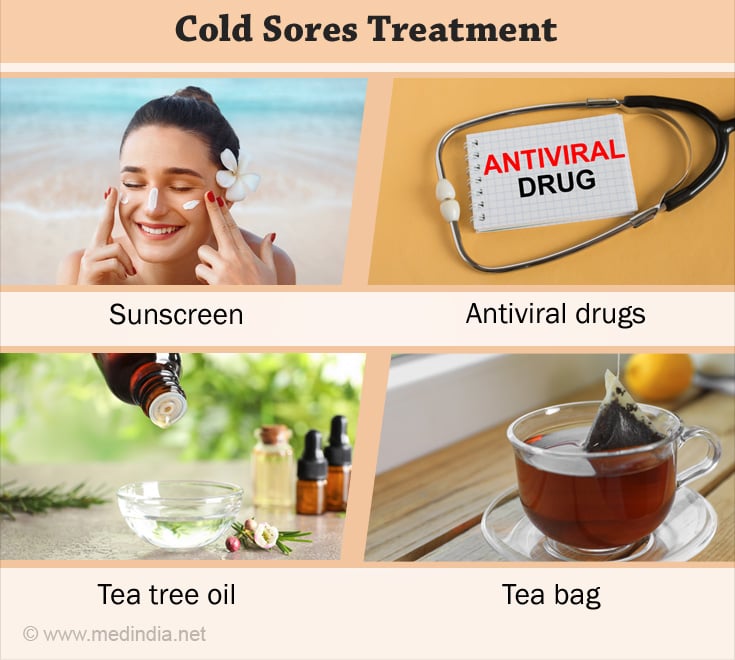
Apply Tea Bag - Tea contains tannic acid and it has been suggested that tannic acid possesses antiviral properties. Placing a tea bag on cold sores when they begin to form especially during the tingle stage can possibly minimize the extent to which they will develop. One should position the moistened tea bag on the area where the cold sore is forming for a few minutes every hour(19✔ ✔Trusted Source
Tannic acid modified silver nanoparticles show antiviral activity in herpes simplex virus type 2 infection
Go to source).
Nutritional supplements - L-lysine an amino acid, has been reported to reduce outbreaks of cold sores but this fact has not been conclusively proven by medical research. Lysine supplements should only be taken only with the recommendation of a health care professional(20✔ ✔Trusted Source
Success of L-lysine therapy in frequently recurrent herpes simplex infection. Treatment and prophylaxis
Go to source).
Herbal remedies - The herbal antiseptics Sage and Tea Tree Oil and the herbal sedative Violet have each been suggested as treatments for cold sores. Herbal treatments must be used appropriately, and therefore should only be used with the recommendation of a health care professional(21✔ ✔Trusted Source
Efficacy of plant products against herpetic infections
Go to source).
Let the cold sores heal by themselves. Avoid squeezing, pinching or picking at any blister.
How to Prevent Cold Sores?
How to avoid getting infected with cold sores?
You can take the following steps to guard against cold sores -
- Avoid kissing and skin contact with people while blisters are present. The virus(22✔ ✔Trusted Source
Herpes Simplex Type 1
Go to source) can spread as long as there are moist secretions from your blisters. - Avoid sharing items. Utensils, towels, straws, glasses, and other items can spread the virus when blisters are present.
- Keep your hands clean. Wash your hands carefully before touching another person when you have a cold sore.
- Be careful about touching other parts of your body. Your eyes and genital area may be particularly susceptible to spread of the virus.
- Avoid triggers. Situations that can trigger cold sores include too much exposure to the sun.
- Use sunblock. Apply sunblock to your lips and face before prolonged exposure to the sun during both winter and summer, to help prevent cold sores.
- Apply a moisturizing balm to prevent the lips from becoming too dry. Lip balms are used to treat cold sores on the lips.
Do not have oral sex if you have oral herpes, especially if you have blisters. You can spread the virus to the genitals. Both oral and genital herpes viruses can sometimes be spread, even when you do not have mouth sores or blisters(23✔ ✔Trusted Source
Herpes - oral
Go to source).